Based on Acts 17:24, where Paul was speaking that God, the creator does not live in shrines made by human hands, the artist Jai ho presented that God in Jesus is present everywhere including our kitchen. This picture is not to domesticate Jesus at our kitchens but to affirm that God in Jesus during this lock down situations is very much present at our kitchens, along with the family members.
The Pattas, our family name reminds me of our roots,our strong and proud Dalit Christian roots, for once we were no people, but God called us and made us God's people,sustains us to journey with God towards liberation and inspires us to be the channels of life. All those who share such experiences as ours are most welcome to join this blog and join hands in making liberation and freedom a reality to all those that are oppressed.
Sunday, May 17, 2020
Drawing the Faith : God in Jesus Present at our Kitchen
Based on Acts 17:24, where Paul was speaking that God, the creator does not live in shrines made by human hands, the artist Jai ho presented that God in Jesus is present everywhere including our kitchen. This picture is not to domesticate Jesus at our kitchens but to affirm that God in Jesus during this lock down situations is very much present at our kitchens, along with the family members.
Friday, May 15, 2020
Whom are we serving at our services? We are a church, only in serving ‘others’ - Reflection from Acts 17:22-31
One of the popular texts that has inspired several missionary endeavours in the history has been Acts 17:22-33, where Paul speaks to the people of Athens, apologetically about the God in Jesus, whom he professed and proclaimed. On the other side, this text has been one of the many texts in the colonial enterprise that was (mis)used to condemn indigenous and non-Christian faith traditions as ‘heathen,’ and criticised other faith traditions as ungodly. This was also a text in the mission history that was utterly (mis)used to justify apartheid and racial segregation as God ordained institution (26v in particular). So, as we read this text today, we are called to read it with much more caution and grace in recognising the voice of God in this Word of God, seeking God’s forgiveness for misreading texts to justify discrimination and oppression of any and every form against the ‘other.’
God is not absent in the unknown:
Finding his teachings strange (19-20v), Paul was brought up to Areopagus (a ‘Mars’ hill, which was an open space for discussions and debates) to explain further about it. Paul had a walk around the city of Athens, recognised how extremely religious they have been (22v), debated with the Jews in the synagogues, with people in the market places, with Stoic and Epicurean philosophers, and now in the open public sphere speaks out his faith in God, not for a publicity but with a public sensitivity. Paul picks a public altar from his observation in the city with an inscription, “To an unknown god,” and took the opportunity to explain his ‘strange’ faith to them. There were many Greek gods and goddesses around the city of Athens which were predominant then. If Paul had to preach God in Jesus as a replacement to their gods, he would have picked one of their well-known gods and would have explained the superiority of Jesus in comparison to them. If Paul had to preach God in Jesus as a fulfilment to their known gods, he would have again picked a well-known god, out of their many gods and would have done that. On the contrary, Paul picked an altar of an ‘unknown god’ and explained his perceptions of God, which he knew in Jesus, which explains his public sensitivity in sharing about the God he knows. Paul begins to share his faith at an unknown place, using an unknown public image, with an ‘unknown god.’ God might be ‘unknown’ to the people of Athens and elsewhere today, but to God there is nothing unknown, for God is not absent from any place and situation. God is ever present and everywhere present for “in God we live and move and have our being” (28v).
As we read it today in our cities and towns, our call is to locate these altars of ‘unknown gods’ or ‘unspoken gods’ in our public sphere to talk about God in Jesus. Speaking about God in Jesus sometimes mean to contest what is unjust, for that is who God in Jesus is. William Cavanaugh in his book, Theo-political Imaginations, explains how state, civil society and globalisation serve today as false-gods offering false salvations, trying to save people from the ‘wars of religions.’ Perhaps there are altars around us as skyscrapers, malls, walls, stadiums, etc. which we might not know as gods, for they have been symbols of creating gaps in the society nurtured by the rules of consumerism and nationalism. Into such altars of ‘unknown gods’ that we are called to speak about our faith in the God in Jesus, who has come to be among the poor, building a just world by preaching good news to the poor, which I always hear as bad news to the rich and greedy.
God does not live in the shrines made by human hands:
In to that altar of the ‘unknown God’ Paul speaks about his know-ledge of God the creator as the Lord of the heaven and earth, for such a God does not live in shrines made by human hands (24v). Paul offers his perspective that God cannot be contained into a particular space, in a way was speaking to those people there who still believed that God is only present in the historical temples, and on some pilgrim sites, for they kept moving from one altar to another seeking to find the presence of God only in a named religious place. As I read it today when our church buildings are locked down due to the pandemic, I hear it again and again that “God does not live in shrines made by human hands.” There have been many who are sad because of the closure of the church buildings, for they miss the worship, fellowship with one another, and also the Lord’s supper. I do understand that, because for many years, that has been their practice and to cope with the closure of the building will be quite distressing to many that came to the church building all their life time. But the situation of lock down is a reminder to all of us that God’s presence is everywhere, and cannot be contained into a building alone, for God is present in our neighbourhood, in our street, in our daily walks, in the nature around us, in our gardens, in our homes, in our study rooms, and in our kitchens. In this situation of ours, God might be helping us to discover that God’s presence exists in places which we did not know and did want to know, and locate God in the unknown spaces, places and people around us. There are some who are trying to open their churches to go in to record their online services and for some private prayers. John whom I mentioned in my introduction said about this, “either we are all in or we are all out,” where he is emphasising there is no privilege for one person to go in and perform on behalf of all people, excluding the rest outside.
My superintendent minister Rev. Cathy Bird in one of our recent circuit leadership meetings and in her circuit pastoral letter this week, challenged us with a very pertinent question, “how is the church being missed today by the community around us?” Answering this question may bring out the need and relevance of our church today, including the relevance of buildings. Cathy further emphasises how has the community, the wider public sphere missed the church during this lock down? Paul is reminding us again, “God does not live in shrines made by human hands.” In a recent survey by Tear Fund, it was said that a quarter of UK adults (24%) say they have watched or listened to a religious service online since the lock down. Why has there been a sudden increase in faith during this lock down? Of the many reasons analysed, I for one think, is this survey not saying to us that people preferred to be part of a religious ‘service’ from home/kitchen rather than coming to a church building? Paul is reminding us again, “God does not live in shrines made by human hands,” for God is ever present in the unknown and in the unthought of.
God is not served by human hands, as though he needed anything:
In to that altar of the ‘unknown god’ Paul speaks, “God is not served by human hands, as though he needed anything” (25v). This verse goes in line with the previous one, for God does not live in the buildings, and he is not served by human hands in such buildings, as though he needed anything. In that context, they believed that God is served by human hands in their designing the image, in their sacrifices by human hands and in their performances of prayers by their human hands. Those days human hands meant ‘able bodied’ human hands, and any offering by disabled human hands were considered sacrilege. So, Paul was offering his perception of God in Jesus, who has come to serve and not be served at all and in all situations. In a way, since God is not needing anything, God is not served by human hands, by which I think we are called to serve people and creation those who are needing anything. Our call during this lock down situation is to serve the vulnerable people, who are in need of help, to serve those hungry who are in need of help, to serve people whose mental being is affected due to this situation by offering pastoral care and to serve those on the margins who are in need of care and help at a moment like this. The message for us is to keep serving those who are needing anything, for in that serving we serve God.
I recognise and appreciate all the contributions and efforts of the people at our churches who keep toiling for the upkeep of the church buildings, and any amount of saying thanks will be insufficient to them. Without their voluntary work, the church buildings wouldn’t have sustained thus far. On the other hand, I also think how many of us thought by going to church in its buildings, and helping with seating, playing music, making coffee, setting up flowers, reading Bible, leading worship, making an offering, preaching, breaking bread etc. that we are actually serving God? What does Sunday ‘service’ mean? Who is serving whom at the worship? This text calls us to introspect our actions, for we are called to serve the least, the lost and the last in the communities around and by serving them we are serving God in Jesus (Matthew 25: 31-40). When many people around us are in need of help, in need of friendships, in need of a person to talk to, in need of a job who has been furloughed, in need of a help with shopping, our call is to serve those needy. For in the first two weeks of the pandemic there has been an 81% increase in demand for food aid, with many going hungry, when calls to helplines for domestic abuse has increased by 120% in a month’s time seeking refuge place, when people from Black, Asian, Minority and Ethnic communities are two or three times more likely to die from coronavirus than the general population in the UK, when this pandemic is not a great equalizer, exposing the bare inequalities in the society for the marginalized communities are disproportionately affected, the calling for Christian ‘church’ is to be in ‘service’ of one another, particularly those on the margins, for by serving the ‘other’ we are serving God.
We can be and become a church only by serving one another in nurturing friendships, relationships and building bonds of trust as an act of our being a church today. To be a church during this lock down is to be in service of one another. Paul goes on to speak, “since God himself gives all mortals life and breath and all things,” (25v), we as a church are called to be givers, giving service to the needy, giving our spaces for those in need, and giving our time and resources for the well-being of our communities.
As Paul in his speech implore the words of a poet (28v), allow me to end with a prophetic poem by Ruth Wells titled, “God snuck home,” which speaks to us and calls to celebrate God who is present in the so far unknown places, at our home and surely at our kitchens. I did hear cynics commenting that by experiencing God in our kitchens are we domesticating Christian faith and privatising it to individualistic self, rather than offering public theology. Habermas would argue that home or oikos was the primary public where rational critical discussions happened, and at a lock down situation like this, experiencing God at our kitchen is a shift of the public, for conversations with children at family prayers at home still yield a needed public theology for our times today. Theology today happens as theo-poetry and as theo-art, for they are the forms of public theology for our times, as they reach out to many people in the public sphere.
God snuck home.
No longer bound by the expectations of a ‘consecrated’ building
She’s concentrated her efforts on breaking out.
Now in the comfort of a well-worn dining table
she shares some bread, with some friends.
And she laughs.
And she weeps.
In the sacred space of home.
Rev. Dr. Raj Bharat Patta,
15th May 2020
Pic credit: http://www.northrock.tv/nurses-rock/
Sunday, May 10, 2020
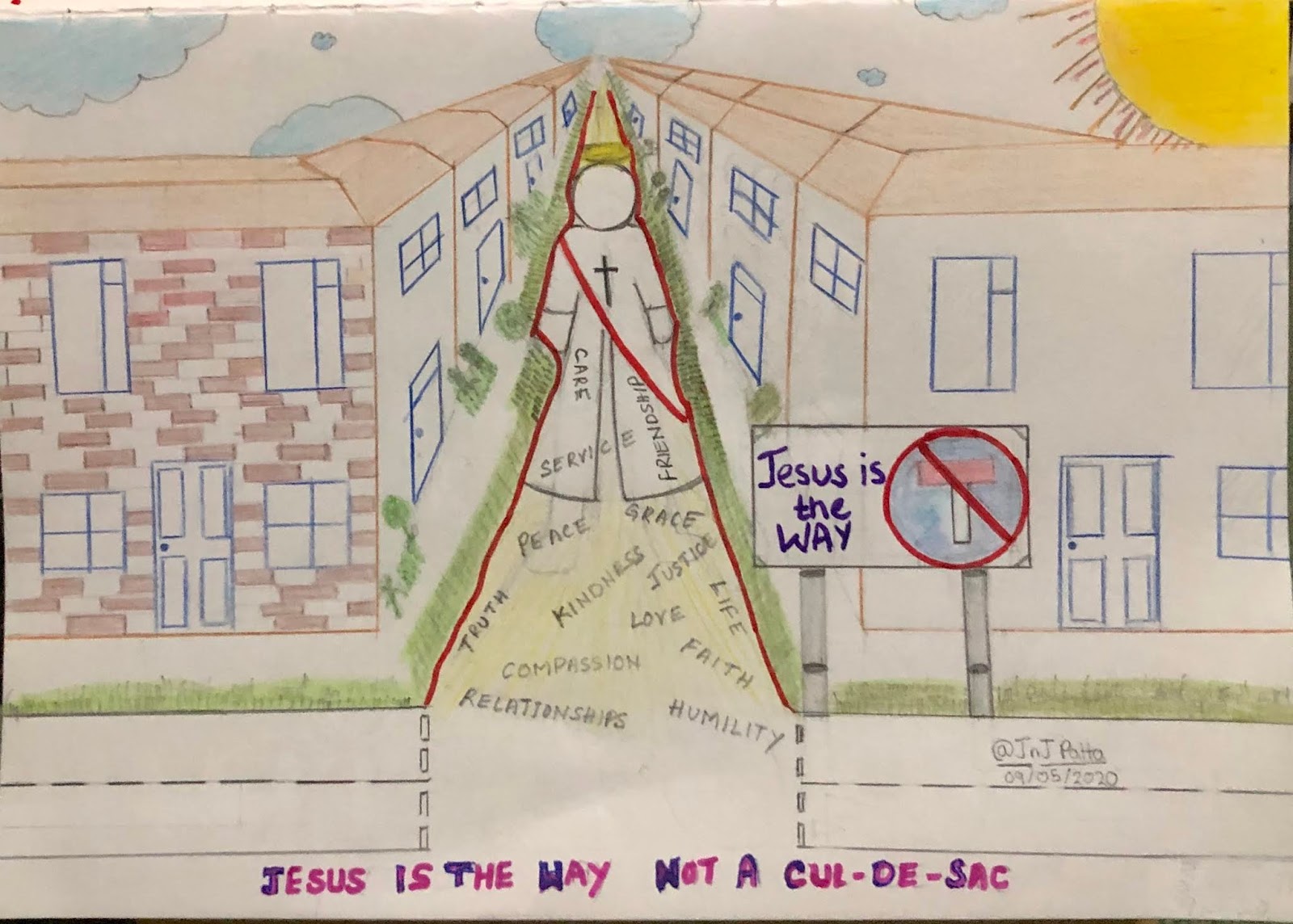
Drawing the Faith: Jesus is the way and not a cul-de-sac
Jubi and Jai ho the artists have drawn the faith in Jesus based on the text John 14:1-6, where Jesus said, "I am the the way, the truth and the life." Jesus is the way and not a cul-de-sac, not a dead end, but a way open to all irrespective of their identity. There is a free flow of grace in this Jesus the way. Jesus the way is full of truth, life, peace, compassion, justice, relationships, friendships, love, faith, humility, service, care, which is open ended. Jesus is the way and not a cul-de-sac. Drawing the faith for faith draws.
Sunday, May 3, 2020
Faith from a Child's Pencil: Jesus the gate for the sheep
Shared with my boys about Jesus' saying, "I am the gate for the sheep" John 10: 7. Here is their reflection with their pencil. The shepherd Jesus sleeping as a gate for the sheep. Hope you have found that sheep of all colour are in Jesus' sheepfold. I think this drawing speaks more powerfully than more words can do. Thank you my boys for inspiring and teaching us. Who said children can't do theology?
Friday, May 1, 2020
It’s ok if you don’t understand: Jesus the gate is open - Reflecting on John 10:1-10
At a time, when the world is locked down due to the virus, how do we understand Jesus’ words to his disciples, “I am the gate” (9v). Or to put it in other words, what is it for us today, when the people across the globe are longing to come out of their locked down experiences, and the text that comes to us this week is Jesus as the gate, the door.
1. Opening the text:
Jesus in opening this text (1-5v) explains to his disciples in a figure of speech using sheep, shepherd, gatekeeper and thieves, analogy to explain about the life of those early followers of the first century. Jesus, picks these agrarian pastoral figures of speech because those were the images of the then public sphere that Jesus and his followers knew. Jesus never missed the opportunity to be publicly sensitive, and always preferred to explain things in the language, images and paradigms of their public space, which they were all familiar with. Perhaps that would be a learning for us today, to be publicly sensitive to the public sphere we live in, and communicate the gospel of Jesus in a relevant language and images that the public can relate with. The message here is that the shepherd comes in all confidence through the gate, whereas the thief comes in means and ways that look fishy and fussy, which includes robbing the sheep. The shepherd leads the sheep outside and the sheep recognises his/her voice and follows, for the shepherd is life-saving and life-assuring. The sheep not only resists to follow the voice of the thief that has come to rob and kill them, but also runs away from this thief to stay with their life-giving shepherd. If I am allowed to open this figure of speech for us today, it would go this way. The shepherd is Jesus Christ, the sheep are the followers, gatekeeper is God, thieves are the intruders who come in the name of consumerism, secularism, oppression, discrimination, patriarchy etc. to steal, to deviate, and to trap the disciples. It is also interesting to note that the shepherd and the gatekeeper are one and the same, but taking two different roles. Not to forget, Jesus is the lamb of God, one among the sheep in that sheepfold.
2. Opening our understandings:
Verse 6, serves as a junction between the first five verses and the last four verses in this text. It reads, “Jesus used this figure of speech with them, but they did not understand what he was saying to them.” Firstly, on the very face of this verse, yes many of us on many occasions did not understand what Jesus has said, in the Word or elsewhere. When Jesus said things figuratively, we have taken it literally, when Jesus said things analogically, we have taken it historically, when Jesus said things contextually, we have taken it universally, when Jesus said things universally, we have taken it alternatively. When we have not understood many things Jesus said, we pretended to have known it all and triumphantly eulogised our words as his words. This verse today calls us to humility to say in the presence of the Lord, yes Lord we have not understood your word as you want us to be understood. This verse also calls us to repentance for we have not understood the words of Jesus as he meant them to be and, in a way, misunderstood his words and excluded several people across histories based on the prejudices of a literal reading of the text. For us as readers today, it is absolutely ok to say that we don’t understand what everything is written in the Word. Jesus does not condemn us for not understanding but appreciates our honesty and works with us to understand things better. This verse also calls us to prayer, asking God in Jesus, the logos to help us understand the words of Jesus and the words in the scripture relevant for our time and context. Secondly, some of the public theological language that is used today may not be understandable to those that consider to be custodians of faith, for they might prefer to listen to the gospel only in their known categories and perspectives. Any attempt of conveying the message differently, different from their convention, tradition, perspective, then they immediately feel threatened, puzzled and insecure. This verse calls us to more honesty to say to Jesus we have not understood your words, and this was what happened in the given text, for they did not understand what he was saying to them.
3. Opening Jesus the gate in its context:
It is in that context when his disciples did not understand what Jesus said, that Jesus speaks again to them with much more public theological clarity and said, “I am the gate”, which is mentioned twice in 7 and 9 verses. To put it into perspective into the context of the text, Jesus in order to open up his figurative speech about shepherd, which was ambiguous to his disciples, picks another image in this case ‘the gate’ as a public faith image to explain about his being and becoming a human shepherd. One public faith image supplements another public faith image to understand it holistically. Jesus as the gate is used here to open the understanding of a shepherd, sheep, gatekeeper and the thief.
Shepherds in the ancient world of first century often built temporary pens for their sheep to sleep in at night. And those pens would have a small opening where the shepherds laid down in front of their sleep. They blocked the entrance with their bodies, so no sheep could go out during the night. Literally, the shepherd becomes the gate, or door, and no predator can get in without first killing the shepherd. This is the image that Jesus is drawing upon when he says in verse 11, “The good shepherd lays down his life for the sheep.” Jesus as the gate explains his being as a gate and also his function as a gate to the sheep. In Jesus as the gate, he explains three functions, one there is safety for his sheep for as he said, “whoever enters by me (Jesus the gate) will be saved,” (9a) and secondly there is freedom for his sheep, “and will come in and go out and find pasture” (9b). Thirdly, Jesus as a gate has come to give life, life in all its fullness to its sheep (10v), in other words to see life is assured to all its sheep. In this entire text we see Jesus taking on the roles of shepherd, gatekeeper, lamb and now as a gate to his sheep. You can imagine the kind of care, support and freedom that this sheepfold was getting from Jesus, who at least plays four roles, including the lamb in that sheepfold.
Back in the day, when I lived in a hostel during my college days, I remember that our hostel doors were open all day and but were closed at 11pm. All of us have to get in by that time, and those that did not enter by then were subject to disciplinary action by the authorities. As it was a student run hostel, there were many arguments about the opening and closing of the doors between students and authorities of the college. It even led to a point where the locks of the entrance door were broken by some students, who were not able to cope with these locking of the gates.
4. Jesus the open gate:
But with Jesus as the gate to his sheep, there is freedom, for the sheep can go out and come in, because Jesus the gate knows his sheep and he has been guarding, caring, nurturing and preparing the sheep as a gate/shepherd/gatekeeper/lamb to face the challenges of the world. This Jesus the gate is not an iron bared gates with high security, allowing sheep only with their ID cards, but a gate with open doors allowing his sheep, whether with documents and no documents, to go out and come in freedom with responsibility, for the sheep follows the voice of the shepherd, wherever they are located in the sheepfold. In that freedom, the sheep enjoyed safety, which John records as ‘they will be saved’. Jesus the gate is a door for the sheep opening to God and to the world, allowing us to live a life in honesty and with responsibility. Jesus the gate is a bridge between sheep, shepherd and gatekeeper, explaining that the shepherd/gate/gatekeeper/lamb finds their meaning in the sheepfold as much as the sheep finds a meaning of their existence in following the voice of their shepherd who plays multiple roles in nurturing and supporting them. Jesus the gate is a shield to the sheep against the wolves and thieves who are trying to attack and deny life for their selfish desires, assuring fullness of life to all people, for that is the reason he has come.
5. Opening Jesus the gate for us today:
At a time when people are frustrated with the lock down experiences, what is the relevance of Jesus the gate to us today? Firstly, Jesus the gate is an open gate gives confidence to his followers to be responsible and to engage with the world when it is safe to go out. Jesus the gate stays with his sheep as a lamb, opens the gates as a gatekeeper under right conditions, and leads the sheep as a shepherd in caring for the world. As followers of such Jesus the gate, we are called to be open to all people, specially building community spirit among our streets, of course with a social distance now. By waving at our neighbours, by listening to our neighbours’ anxieties and by helping our vulnerable neighbours, Jesus the open gate comes alive today. Secondly, Jesus the open gate mediates safety of its people and their participation in the world under the divine protection of the Good shepherd. Thirdly, Jesus the open gate is an affirmation to protect the vulnerable communities, for God in Jesus recognises the injustices around, disproportionately affecting the marginalised communities and offers hope in keeping them safe. Fourthly, like the disciples sometimes we do not understand the relevance of the image of gate at a time like this, but Jesus the gate helps in struggling with us to understand that he is not a dictatorial God trying to fix things from above, but working with the communities on the ground in overcoming this phase of the crisis, he willing to be a gate and inviting us to be gates for our communities in offering care, freedom and support. Fifthly, I see the relevance of Jesus the gate in all those care and medical workers who are nursing the people with PPE or not, risking their own lives and in saving several people’s lives today. Lastly, as churches we are called to be such open gates like Jesus offering care, nurture, nursing, and supporting our communities, even when we are closed as buildings, towards building new creations where life is lived in all fullness.
When the locks of our hostel doors were broken, the authorities understood the frustrations of the students and eventually left the doors open by trusting in the student’s responsibility and by building in their confidence.
Jesus the gate is always open to all people of God, and may all our sheepfolds reflect such an open Jesus in our welcome and inclusion of all people.
Rev. Dr. Raj Bharat Patta,
1st May 2020
Subscribe to:
Posts (Atom)
When the Sun Is Veiled: A Christian reflection on wonder, faith, science and care for creation
Viewing a solar eclipse as an Indian Christian in post-secular Britain “The heavens are telling the glory of God; and the firmament proclaim...
-
Jesus spoke to his disciples in parables about the mysteries of the kingdom of God as ‘they were able to hear it’ (33v). In this given text ...
-
Andhra Evangelical Lutheran Church Turns 166 Re-forming the Mission agenda without De-forming the Gospel values Reminiscing the past On a d...